Games For Windows Live
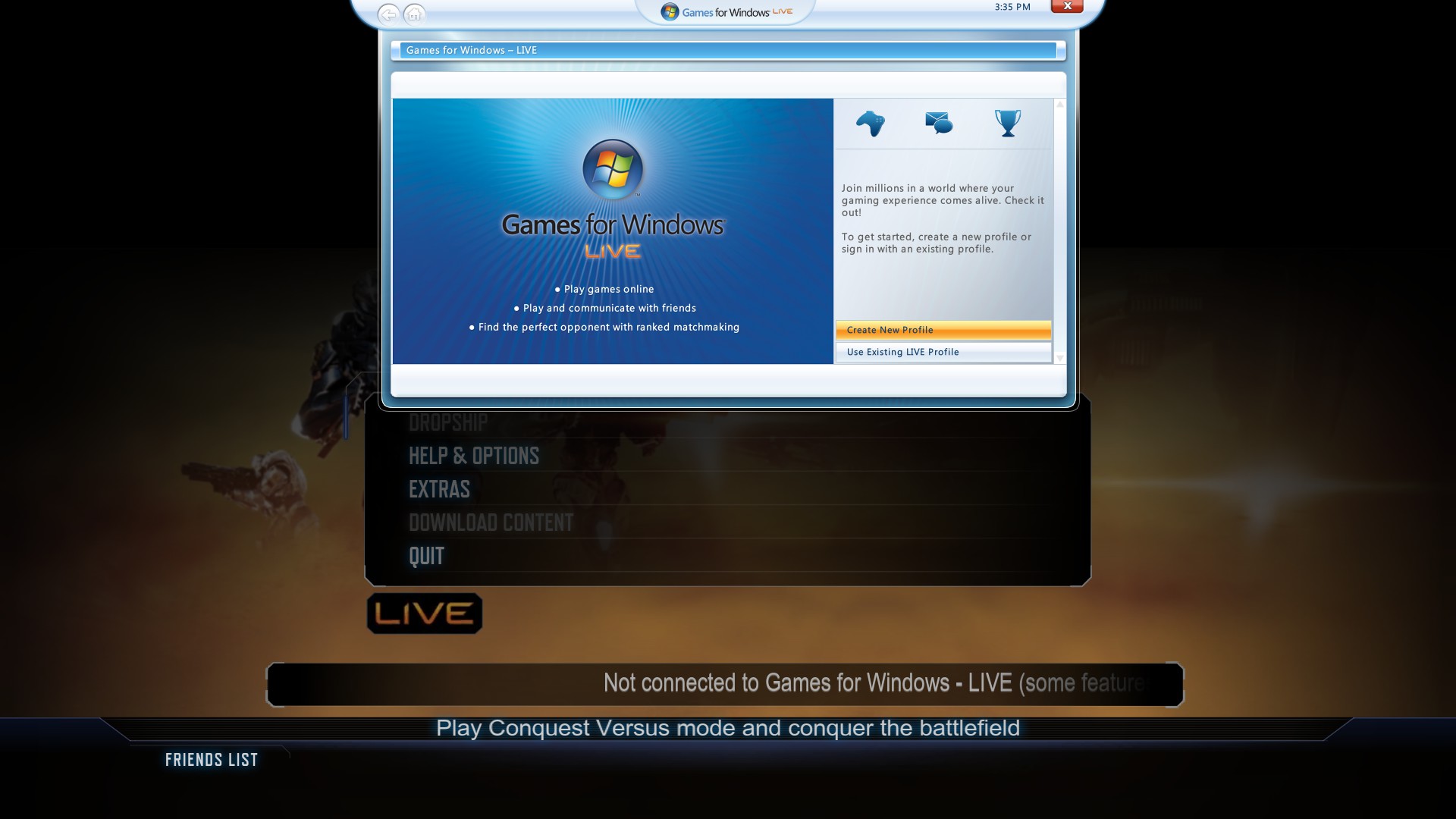
Setup package for Games for Windows - LIVE. The package installs all the Games for Windows - LIVE Redistributable that enables the in-game Games for Windows - LIVE experience as well as the Games for Windows - LIVE Client that enables the out-of-game experience, including Games for Windows - LIVE. Games for Windows Live Offline Installer is the most powerful gaming application, which provides you with the access to the games. Games for Windows Live allows access to a small social network with many of the Xbox Live’s features.
Games for Windows – LiveType. (DRM).Launch dateGames for Windows – Live:May 29, 2007 ( 2007-05-29)Games on Demand:December 15, 2009 ( 2009-12-15)3.5.95.0February 20, 2014 ( 2014-02-20)Designed for, and; Still works on, andStatusDiscontinuedGames for Windows – Live or GFWL (trademarked as Games for Windows – LIVE ) was an online gaming service used by –branded titles that enables PCs to connect to Microsoft's service. Users, each with a unique (the Microsoft username service for gaming that began on ), are able to play online, keep track of their friends' status, send and receive messages, gain and keep track of Achievements and associated, voice chat across platforms (removed in 2010), and much more. Some games allow for cross-platform play, such as, putting Windows players against players.The service is open to third-party developers, but they must be able to meet certain Technical Certification Requirements (TCRs), which include (but are not limited to): game ratings, total number of Gamerscore points, content, game profiles, and Live connectivity. Games for Windows – Live games must also meet standard Games for Windows (games that do not have Live support) TCRs.
The same developer support infrastructure is available as with the. Assistance to developers is provided through the Developer Connection. Contents.History The first Games for Windows – Live-enabled title was, which launched simultaneously on and on May 29, 2007, and was also the first LIVE title to offer cross-platform play between and on the Live service.Another game that was released is for Windows Vista, which was launched to the public on May 31, 2007.
The game supports all the standard Live features (such as achievements, voice chat, messages, etc.), but does not offer cross-platform play with players., and have signed on to include Games for Windows – Live in their upcoming games. Also included this service in their. From Sega and Lost Planet: Colonies Edition from Capcom include cross-platform play between Xbox 360 and Windows over Live.On July 22, 2008, Microsoft's Chris Satchell, CTO of the company's Entertainment devices division, announced that Games For Windows – Live would be free to developers.
Previously, select publishers and developers used the system and had to pay for it. Also, all Games For Windows – Live features were now free for gamers, such as matchmaking and cross-platform play.
Satchell added that the move was a 'way to improve Windows gaming'.As well as free multiplayer, Microsoft reduced the technical requirements for those developers looking to utilize Live such as removing playlist servers, and allowing studios to use the Microsoft matchmaking servers instead. The new Marketplace was made available for Games for Windows – Live on December 5, 2008. Microsoft also released the newly designed User Interface, on November 12, 2008.On January 7, 2010, it was announced at CES that the upcoming Xbox Game Room would be made available on both the and Games for Windows Live services.
However, games purchased with 240 Microsoft Points will only be playable on one of the platforms; either Xbox 360 or PC. A dual-platform license will cost 400 Microsoft Points. As the Game Room will be available to Gold and Silver Xbox members, the service will be free to use on Games for Windows Live. Arcade games will feature achievements and online leaderboards.Microsoft revealed on May 21, 2010 that would be released on as well as the, and would feature Games for Windows – Live. The downloadable version will be a Games on Demand exclusive.On August 17, 2010, Microsoft unveiled two new games at 2010 that will use Games for Windows – LIVE,. Age of Empires will be free-to-play through LIVE. On September 24, 2010, ' general manager Dave Luehmann said in an interview the studio's renewed focus will start with three big titles— Fable III, Age of Empires Online and Microsoft Flight—which will use Games for Windows – LIVE.
Luehmann reassured PC gamers that more big titles were on the way, however the studio plans to test new ideas.On September 13, 2011, confirmed what is bringing to, being called Xbox Live on Windows.On March 26, 2012, announced the arrival of on. Age of Empires Online was released on Steam on March 27, 2012. On April 3, 2012, was released on Steam. Microsoft Studios release on April 17, 2012 and on April 27, 2012 in Games for Windows – LIVE.
On April 17, 2012, Microsoft said that they continued to support the Games for Windows platform, to the rumors of the discontinuation of Games for Windows – LIVE in favor of Xbox Live on Windows. On April 13, 2012, Microsoft Studios release, and is the first Microsoft Studios title available only on Steam.On August 31, 2012, became and dropped Games for Windows – LIVE in favor of.

On October 10, 2012, the Steam version of Toy Soldiers was updated to fully use Steamworks, although it still gives the option to use the original service. On October 16, 2012, was the first title of Microsoft Studios to use Steamworks exclusively, instead of GfWL.
On October 25, 2012, became the second title of Microsoft Studios to use Steamworks exclusively. On November 28, 2012, became the first (and only) retail Games for Windows – LIVE title announced for 2013.On January 31, 2013, Microsoft Studios said that they 'have nothing to share on the future of Games for Windows Live'. On March 7, 2013, Microsoft Studios announced + would be released exclusively on. On April 3, 2013, was released by Microsoft Studios on both platforms.
On August 9, 2013, Microsoft announced the removal of one of the most criticized limitations for the LIVE platform, the inability of simultaneously in on both the Xbox One and Games for Windows LIVE.On August 16, 2013, Microsoft announced that the Xbox.com PC Marketplace was going to be closed on August 22 alongside the Xbox 360 update that retired Microsoft Points in favour of local currency purchases. The service would otherwise continue to operate normally.In August 2013, a since-deleted support article for announced that the Games for Windows – Live service would be discontinued on July 1, 2014. Microsoft issued a statement in June 2014 denying they were closing Games for Windows Live, stating 'We remain committed to investing in PC gaming in the years ahead, and look forward to sharing more in the future'. After the initial August 2013 support article, some game publishers announced that they would be removing GFWL from their games, but in most cases this did not happen until several years later or at all. Microsoft closed Games for Windows LIVE on 15 August 2013: 'As part of the upcoming Xbox 360 system update, Microsoft Points will be retired, and the Xbox.com PC marketplace will be closed as of August 22, 2013.
We encourage you to spend your Microsoft Points balance prior to this change'. The download of the client software is still available, and the servers are still online.Games for Windows Live has since been spiritually replaced with the for Windows 10 & Windows Phone.Features.
Achievements earned during gameplay. Gamerscores amounting the total of a user's achievement points. Reputation voted by other users preferring or avoiding the user. Rep defaults to five stars over time after the user has been preferred by at least one other user. displaying the user's chosen friends of up to 100. Recent players list displaying the last 50 players the user has met.
Complaint system allowing users to file reports of other users that have broken Live. offered, music and movies until its closure in 2013. Public and private chat via.
The voice feature worked between Xbox 360 and Windows until 2010, when Microsoft updated the voice codec for Xbox Live. Games, such as Shadowrun, now only support the text portion of this feature. Multiplayer gameplay via Games for Windows – Live. Matchmaking depending on the user's cumulative gamerscore, rep, location, language and gamer zone. controlling younger users' exposure to other users. virtual arcade space offering a library of classic retro games. gameplay withUser information Gamertag.
Main article:A Gamertag is the universal name for a on Games for Windows – Live, as well as, and Creators Club. A Gamertag used online must be unique and can be up to 15 characters in length, including numbers, letters, and spaces.A player's Gamertag account status can be checked using a variety of online tools, which is useful especially when looking for a new Gamertag, or confirming that a Gamertag exists. Using a valid Gamertag, any player can be located and messaged from within Live. There are also several websites which allow users of Gamertags to upload photos and information about themselves.Gamerscore. Main article:The Gamerscore (G) is an system that measures the number of achievement points accumulated by a user with a Live profile. These Achievement points are awarded for the completion of game-specific challenges, such as beating a or amassing a specified number of wins against other players in online matches.All regular disc-based games must have 1,000 Gamerscore points in the base game; the title can ship with fewer than 1,000 points, but anything added later must be free.
Also have the option of adding up to 250 points via downloadable content every three months after the first year of release (for a total of 1,750 points).On May 26, 2007, was the first Games for Windows – Live title to feature Achievements, which counted towards a player's Gamerscore.Gamercard. Main article:TrueSkill is a ranking and matchmaking system premiering in the Live services.
Developed at Cambridge , the TrueSkill is now used in many titles for Games for Windows – Live. It uses a of uncertainty to address weaknesses in existing ranking systems such as. For example, a new player joining million-player leagues can be ranked correctly in fewer than 20 games. It can predict the probability of each game outcome, which enhances competitive matchmaking, making it possible to assemble skill-balanced teams from a group of players with different abilities.When matchmaking, the system attempts to match individuals based on their estimated skill level.
If two individuals are competing head-to-head and have the same estimated skill level with low estimate uncertainty, they should each have roughly a 50% chance of winning a match. In this way, the system attempts to make every match as competitive as possible.In order to prevent, the majority of ranked games have relatively limited options for matchmaking. By design, players cannot easily play with their friends in ranked games.
However, these countermeasures have failed due to techniques such as alternate account(s) and system flaws where each system has its own individual trueskill rating. To provide less competitive games, the system supports unranked Player Matches, which allow individuals of any skill level to be paired (often including 'guests' on an account). Such matches do not contribute to the TrueSkill rating.User interface The user interface or 'Guide' was changed from earlier versions (made to match the Xbox 360's original appearance) to a new appearance. The guide includes messaging (text and voice), friends list, recent players, private chat, and personal settings.The current version of the in-game Live client is version 3.5.0088.0, released on May 6, 2011. It is available for (Service Pack 2 and above),. Version 3.0 added extended information about progress and some bugfixes.
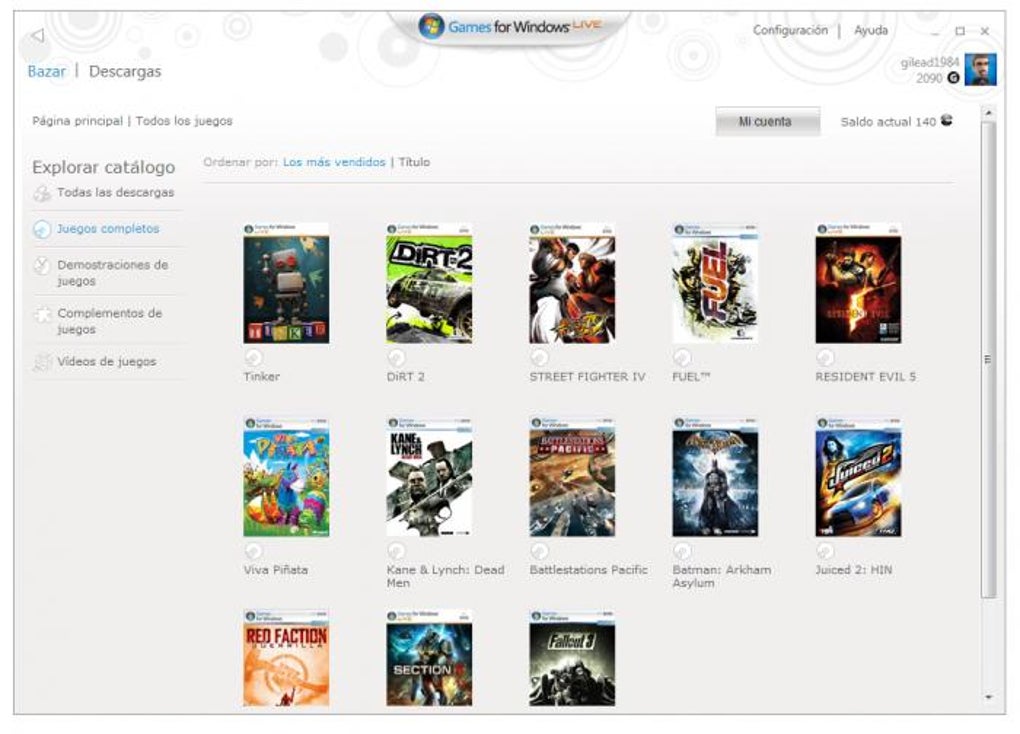
The client also auto-updates when users are logged-on to a Live-aware game.Marketplace The Games for Windows Marketplace client was officially released on December 4, 2009. It initially launched with demos and trailers of games available on the Live service. Full titles were later added in the form of.With version 3.0 of the Games for Windows – Live service, a in-game marketplace was included; in addition to new account management tools, such as the ability to change a Gamertag for 800 Microsoft Points. The in-game marketplace enables users to purchase without exiting, as it installs the content directly from within the game.On July 22, 2011, Microsoft announced that they would be scrapping the newly revamped Games for Windows Marketplace website and merged the content with the Xbox website. The Games for Windows client, which was another way for users to purchase games, was also reduced to simply opening up the Windows section of Xbox.com. On August 15, 2013, Microsoft announced that the marketplace would be closed on August 22 of the same year.
Games on Demand. Main article:On December 15, 2009, Microsoft launched Games on Demand, a service offering titles such as. Also available are arcade games such as a free version of, a former exclusive to Ultimate, as well as and.Some titles bought on Games on Demand include Server Side Authentication. This is a Games for Windows – Live 3.0 feature that automatically ties the game to your and the Gamertag associated to it. These games have no activation limits and can be re-installed multiple times. The majority of the other titles on the service use a that lets the user activate the game up to five times each month on any hardware.On June 8, 2010, some games which were previously not titles were added for download. Microsoft had claimed that new titles would be added every week and that there would be over 100 games by the end of 2010.On October 22, 2010, Microsoft announced a revamp of Games On Demand under the new branding Games for Windows Marketplace.
However, this was met with low expectations from reviewers, considering the history of Games for Windows Live on PC. On July 22, 2011, less than a year after the revamp, Microsoft announced that it would merge the Games for Windows Marketplace into the Xbox website. Availability As of February 10, 2015 Games for Windows – Live is available in 42 countries/territories. Users in other countries can access Live by creating a Gamertag using an address from a supported country, although no technical support is available outside of the supported countries.
Since Games for Windows – Live is based on the Xbox Live service, availability is exactly identical to the regional availability of Xbox Live. The Marketplace is not available for all of these regions.Controversies After the official announcement of Games for Windows – Live, many PC gamers were upset with Microsoft's move to charge PC gamers a fee of $49.99 to use the service. Many PC gamers felt this move was unfair, as playing online and many of the other services GFWL offered has, for the most part, always been free on the PC. Microsoft later began offering the service free of charge, after many complaints from PC gamers were made.After the announcement that the PC release of would use Games for Windows – Live, fans started up a petition to have the game released without the service attached. The online petition gained over 20,000 signatures in 5 days, reflecting a notable public dislike of the service among PC gamers.Many users who bought their game via had trouble activating CD-keys in-game via the integrated Games for Windows – Live client. See also. ^ Sinclair, Brendan (May 24, 2007).
Retrieved 24 December 2009. ^ LeBlanc, Brandon (December 18, 2009). Windows Team Blog. Retrieved 24 December 2009. Retrieved 2008-07-28.
Games For Windows Live Installer
Archived from on 2008-07-24. Retrieved 2008-07-28. Minkley, Johnny (2006-08-22). Retrieved 2008-07-28.
Chris Remo, Christian Nutt (July 22, 2008). Retrieved April 7, 2009. French, Michael (2008-07-22). Retrieved 2008-07-28. January 14, 2010, at the. May 22, 2010, at the. August 19, 2010, at the.
(2011-09-13). AOEO Trajan (2012-03-26). Announcements Blog.
2012-04-03. (2012-04-17). @tequilaworks Does the PC version use Games For Windows Live? Thanks -@FunktionJCB@FunktionJCB Nope -@tequilaworks. joar (2012-11-28). Archived from on 2013-06-03. John Callaham (2013-01-31).
Samit Sarkar (2013-03-07). Kirk Hamilton (2013-08-09). Retrieved 2013-11-01. Maiberg, Emanuel (June 21, 2014). Retrieved June 22, 2014.
Retrieved 2013-11-01. Retrieved 2013-11-01. Retrieved 2013-11-01. Retrieved 2013-11-01. Retrieved 2013-11-01. Retrieved 2015-04-18.
Retrieved 2015-04-18. Archived from on 2008-12-10. ^ LeBlanc, Brandon (July 22, 2011). Windows Team Blog. Retrieved 4 April 2012. 2013-08-15. David Scammell (2013-08-15).
VideoGamer.com. Carlos Leiva (2013-08-15). (in Spanish). Xbox Team (December 3, 2009). Gamerscore Blog. Retrieved 24 December 2009. ^ Peckham, Matt (December 16, 2009).
Retrieved 24 December 2009. Fahey, Mike (December 3, 2009).
Retrieved 24 December 2009. GFWL GHOST (2011-05-16). Retrieved 2014-01-02. June 11, 2010, at the.
Games For Windows Live Marketplace
^. Retrieved 2010-11-02. Retrieved 2010-11-02. It's all a step in the right direction, but Microsoft is severely behind Steam, which revamped its entire marketplace and client earlier this year.
Retrieved 2010-11-06. That announcement was greeted with a fair amount of scorn from the PC gaming world—so it remains to be seen if the US giant is already facing an uphill battle.
'After years of failing to turn Games for Windows Live into a useful service to gamers, people are going to be skeptical of anything Microsoft try to do in the same space, said PC Gamer's Graham Smith. Rego, Nick (2012-10-20). Retrieved 2012-10-20. Retrieved 2012-11-02. Makuch, Eddie.
Archived from on 20 April 2012. Retrieved 16 April 2012. GFWL Support (2012-09-05).